Word Stacks
- 4.6
- Rating
- 10.00M
- Installs
- Free
- Price
 Analysis by App-foxy
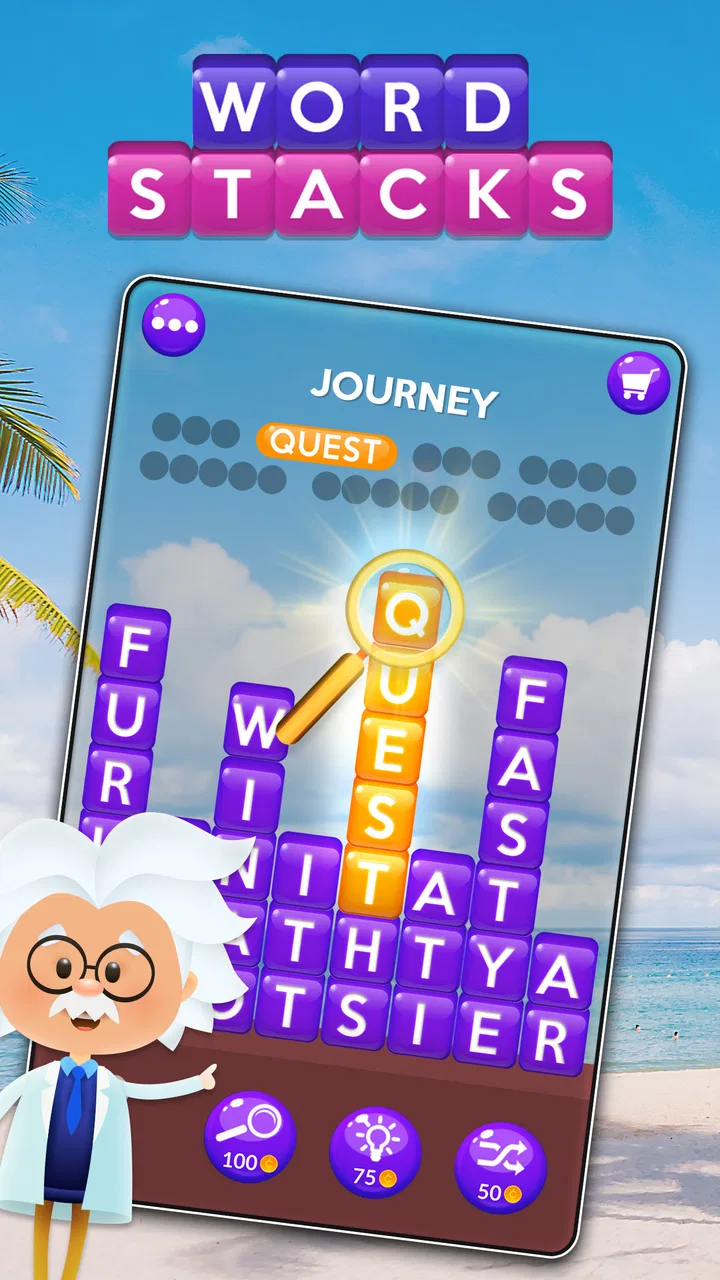
I spent time with Word Stacks as a casual word game, and my first impression was that it is easier to pick up than a traditional crossword but more deliberate than a basic word-search puzzle. The central appeal is simple: you look for words inside a compact letter arrangement, then use your choices to work through the puzzle. That makes it a comfortable game for short breaks, yet it still asks you to think rather than tap through a completely passive activity.
It comes from PeopleFun and sits in the word-game category. The game is free to download, carries an Everyone age rating, and supports devices running Android 6.0 or later. Its current version is 1.27.0. Those details make it broadly accessible, especially if you want something that can live on an older compatible phone instead of demanding recent hardware.
How the word puzzles feel in everyday play
The best way to understand the experience is to forget the usual crossword grid for a moment. A crossword normally gives you clues and a fixed structure, while a conventional word search encourages you to scan for hidden terms in a block of letters. This game blends the familiarity of both ideas into a more compact routine. I found myself looking at the available letters, spotting a possible word, and then reconsidering the remaining arrangement after each successful choice.
You May Also Like

 Blood Strike: 2.5 Anniversary
Blood Strike’s Loadouts Turn Every Drop Into a Tactical Gamble
A close look at Blood Strike’s custom loadouts: how fast access to signature weapons reshapes its battle royale rhythm, rewards preparation, and narrows the gap between fights.

 Pandora - Music & Podcasts
Pandora’s Music Is Easy to Start, but Harder to Recover
Pandora’s strength is its low-effort path from a seed to a station. Its weak spot is how much confidence it asks you to place in connection, setup, and quiet recovery.

 8 Ball Pool
 Is Built on Rivalries, Rematches, and Routine
A close look at the rivalries, rematches, shared routines, and unanswered safety questions that turn a quick pool match into a persistent mobile community.

 Samsung Music
’s Quiet Strength Is Playing What You Already Own
Its reach comes less from spectacle than from dependable access to a personal library. That simplicity is both the app’s strongest retention engine and its ceiling.

 AccuWeather: Weather Radar
AccuWeather Review: A Quick, Clear Forecast for Everyday Decisions
For everyday plans, the best forecast is the one you can understand quickly. AccuWeather makes rain timing, radar, and local conditions easy to act on, with a few trade-offs.

 Hill Climb Racing
Why Hill Climb Racing Still Turns Crashes Into One More Run
A tiny car, a bumpy hill and one more upgrade: Hill Climb Racing keeps resurfacing because its simple chaos makes every near-miss feel personal.
More From Our News Desk
View All News


That changing perspective is where much of the enjoyment comes from. A word that seems obvious at first may not be the most useful one to choose immediately. When I slowed down and examined the surrounding letters instead of grabbing the first recognizable combination, I generally made better progress. This makes the game feel less like a vocabulary test and more like a small visual-planning exercise.
The controls are well suited to touch play. You can approach a puzzle with one hand while standing in a queue, sitting on public transport, or waiting for an appointment. I also like that the format does not require the long concentration session associated with a newspaper crossword. A few minutes can feel complete, and returning later does not demand that you remember a complicated story or a large set of rules.
At the same time, this is not the ideal word game for every mood. If you want detailed clues, unusual definitions, or a strict test of general knowledge, a serious crossword app will probably offer more depth. If you only want to find words without any sense of progression, a standard word search may feel more direct. The attraction here is the middle ground: familiar letter hunting with enough structure to make each solved arrangement feel earned.
A practical routine for solving difficult boards
My most useful habit was to scan in layers rather than searching randomly. I first looked for short, obvious words, then checked whether a longer possibility appeared after those letters were removed or accounted for. This prevented me from repeatedly staring at the same pattern. It also made the board feel less crowded, because every correct choice reduced the number of possibilities I had to consider.
Another helpful approach is to read the letters in more than one direction. People naturally search horizontally, but a word puzzle like this rewards checking vertical and diagonal relationships as well. I also found it useful to pause before selecting a word that looked attractive but left an awkward group of letters behind. That small delay is one of the clearest differences between thoughtful play and hurried tapping.
When I was stuck, I did not immediately assume that I had missed a rare word. Often the problem was that I was locked into one visual pattern. Looking away for a few seconds and returning with a fresh scan worked better than forcing the same guess. This is a simple tip, but it matters on a phone because the compact display can make several possible paths blend together.
These habits also reveal a trade-off. The game is relaxing when you enjoy visual deduction, but it can become mildly frustrating when the board seems to depend on seeing one particular connection. Someone who dislikes trial and error may prefer a clue-based format that explains exactly what kind of answer is expected. Here, the satisfaction comes from recognizing the answer yourself, and the irritation comes from the same source when recognition does not arrive.
What makes it useful beyond a spare-minute distraction
I would not describe it as a language-learning course, because the main activity is solving rather than teaching vocabulary. Still, it can be a pleasant way to keep word recognition active during small gaps in the day. I used it most successfully when I wanted something more engaging than scrolling but less demanding than reading a long article.
A realistic example is a short evening reset after work. I could play a few puzzles while waiting for dinner, stop without losing the whole evening, and return to another puzzle later. The format gave me a clear endpoint, which is useful if you are trying to avoid opening an endless social feed. It is also suitable for a quiet family setting where one person can pass the phone around and discuss possible words, although the experience remains primarily designed for individual play.
There is a subtle advantage in the way the game encourages reconsideration. You are not merely checking whether a word exists; you are judging when to use a promising word and how that choice affects the rest of the arrangement. That makes it a better fit for players who enjoy small decisions and pattern recognition than for people who want a rapid-fire vocabulary quiz.
On the other hand, I would not use it as my only word-game option. Repetition can become noticeable if you play for long stretches every day, particularly if your ideal game is built around increasingly complex clues or a broad dictionary challenge. Its strength is the short, focused session, not necessarily an all-night marathon.
Free access and what the purchase question really means
The important cost point is straightforward: the game is free to download. That lets you try the core experience before deciding whether it deserves a permanent place on your phone. The listing also includes in-app purchases ranging from $0.99 to $99.99 per item. Because those options span a wide range, I would treat any purchase as optional convenience spending rather than assume that paying is required to understand the game.
That distinction matters when judging value. The free entry point has a clear advantage for occasional players: you can test whether the word-search-and-crossword blend suits you without committing money upfront. If you only play during commutes or short waits, free access may already provide enough value. For a dedicated player, the appeal of an in-app purchase depends on what it changes in the personal experience, so I would make that decision only after using the free version long enough to know whether the puzzles remain enjoyable.
I also recommend checking the purchase screen carefully before confirming anything. The available price range means that not every option represents the same level of commitment. A small optional purchase and the highest listed item are very different spending decisions, even though both appear under the same game. I would avoid buying simply because a difficult puzzle has slowed me down; frustration is a poor reason to spend.
From a value perspective, the game works best when you see it as a reusable pocket activity rather than a one-time challenge. Free access lowers the risk, while the purchase choices make it possible to spend more if you decide the experience is worth supporting or enhancing. My recommendation is conservative: play first, identify whether the basic loop keeps you interested, and only then consider whether any paid option adds enough value for your habits.
Where the experience can lose momentum
The compact format has a visual cost. On a smaller phone, letter relationships may require more concentration than they would on paper. I occasionally found myself moving my attention around the same area without being sure whether I had already checked a possible path. Players with visual fatigue or a preference for large, spacious layouts may find a traditional crossword easier to read.
The game can also feel less satisfying if you need an explanation for every answer. A clue-based puzzle tells you why a particular word belongs; this style focuses more on finding and arranging words than on teaching definitions. That makes it approachable, but it also means the intellectual reward is mainly the “aha” moment of discovery rather than learning a new fact about language.
Another limitation is the balance between calm and repetition. Short sessions are its natural territory, but extended play can expose the basic loop more clearly. I would not call that a flaw in the concept; it is simply a reason to match the game to the right use case. It is excellent as a small daily diversion and less convincing as a substitute for every other word puzzle on your device.
There is also a personal tolerance issue around difficulty. Some players enjoy sitting with an arrangement until the answer appears, while others interpret that pause as unnecessary friction. If you want constant forward motion, you may prefer a game with more direct clues or a simpler word-search structure. If you enjoy examining a board and testing your visual assumptions, the same pause can be the most rewarding part.
Who is most likely to get good value from it
I think the strongest audience is made up of casual players who like words but do not want to study rules before starting. It is approachable enough for a quick first session, yet the changing letter patterns give experienced puzzle fans something to think about. It also suits people who want an activity with natural stopping points rather than a game that pressures them into a long continuous session.
It may be a good choice for someone replacing idle scrolling with a small mental challenge. The free download makes that experiment easy, and the Everyone rating means it is positioned for a broad audience. I would also recommend trying it if you enjoy crossword-style thinking but sometimes find traditional clues too demanding or too slow to complete on a phone.
I would be more cautious if your priority is competitive play, deep progression systems, or a large educational component. Nothing about the basic concept makes it a replacement for a serious crossword collection, a vocabulary trainer, or a multiplayer word battle. Those alternatives are better when you want measurable competition, detailed instruction, or a stronger sense of long-term mastery.
It is also not my first recommendation for someone who dislikes visual scanning. The game asks you to notice relationships among letters, and that is central rather than incidental. If you prefer being given a definition and entering an answer, the usual crossword format will probably feel more natural. Choosing the right alternative depends less on skill level than on whether you enjoy discovering patterns without a conventional clue.
Popularity, compatibility, and everyday expectations
The game has reached over ten million installs and holds a 4.6 average from around two hundred fifty thousand ratings, with roughly sixty-one thousand written reviews. Those figures suggest that the format has connected with a large casual audience, although popularity alone should not decide whether it fits your taste. I see the numbers as reassurance that this is an established word-game choice, not proof that every player will enjoy its particular rhythm.
Its release date was October 3, 2018, so it is not a brand-new experiment. That can be a positive for someone who prefers a mature, familiar title over a newly launched game whose direction may change quickly. The current version is 1.27.0, and the minimum operating system is Android 6.0. Before installing, I would still check that your phone meets that requirement and has enough comfortable screen space for reading the letter arrangements.
The age rating is Everyone, which makes the game a reasonable option for a shared household device. I would still supervise younger players as I would with any app involving optional purchases, especially because the listed in-app purchase range extends from $0.99 to $99.99 per item. The free starting point is friendly, but purchase awareness is part of using it responsibly.
My verdict on whether to install or skip
My overall opinion is positive, with a clear condition: Word Stacks delivers the most value when you want short, thoughtful word puzzles rather than a complete crossword replacement. I like the way it turns familiar letter searching into a small planning exercise, and I appreciate that I can begin without paying. The experience is approachable, portable, and easy to fit into ordinary moments.
I would install it if I wanted a free word game for commutes, waiting rooms, quiet breaks, or a few minutes before bed. I would also recommend trying it to a friend who enjoys spotting patterns but does not want the pressure of a timed competition. The free entry makes the decision low-risk: use it for a while, notice whether the visual solving loop stays enjoyable, and then decide whether any optional purchase is worthwhile for you.
I would skip it if I needed rich clues, advanced vocabulary lessons, head-to-head competition, or a puzzle format that explains every answer. In those cases, a dedicated crossword, word-learning app, or competitive word game would be a better match. The same is true if compact letter layouts quickly tire your eyes or if you lose patience when a solution depends on seeing one overlooked connection.
For me, the final balance is favorable because the game knows what it is. It is not trying to replace every kind of word entertainment. It offers a focused blend of word search and crossword thinking, with free access and optional spending that should be approached thoughtfully. If that particular blend sounds appealing, PeopleFun’s game is worth trying; if you want a deeper or more competitive word experience, keep looking.
FAQs for Word Stacks
01What is Word Stacks and how is the game played?
Word Stacks is a relaxing word puzzle game in which you swipe across letter tiles to form hidden words. Each level presents a themed collection of letters, and you must find the correct words to clear the board. The difficulty gradually increases, while the simple controls and short levels make it suitable for quick sessions or longer casual play.
02Is Word Stacks free to download and play?
Word Stacks can generally be downloaded and played for free, although it may include advertisements and optional in-app purchases. Players can usually progress without paying, but purchases may provide hints, remove ads, or offer other conveniences. Before downloading, it is worth checking the current store listing because pricing, advertising, and available purchase options can change.
03Does Word Stacks work without an internet connection?
Many of Word Stacks’ basic puzzles can be played offline after the game has been installed, which is useful during travel or when you have limited mobile data. However, certain features may require an internet connection, including advertisements, purchases, updates, or online services. Offline availability can also vary by version, so testing the game before traveling is recommended.
04Is Word Stacks suitable for children and educational use?
Word Stacks is accessible for many children because it uses straightforward swipe controls and familiar word-based gameplay. It can help players practice spelling, vocabulary recognition, and concentration, although some later puzzles may be challenging for younger users. Parents should review the game’s age rating, advertising, and in-app purchase settings before allowing unsupervised play.
05Are there hints or ways to solve difficult Word Stacks levels?
Yes, Word Stacks typically provides hint-related options or other assistance when a player becomes stuck. These tools can reveal letters or help identify possible answers, but they may be limited or connected to coins, rewards, advertisements, or purchases. It is often better to first rearrange the visible letters, look for common word patterns, and use hints sparingly.
Pros
- Simple swipe controls make it easy to start playing immediately.
- Short levels are convenient for quick breaks or casual sessions.
- Word themes add variety and help give each puzzle a clear focus.
- Gradual difficulty increases keep the early stages approachable.
- Offline play is useful when you have no internet connection.
Cons
- Some answers may feel obscure if your vocabulary is limited.
- Repeated puzzle patterns can become predictable over time.
- Hints are limited
- so difficult levels may require extra patience.
- The game may feel too easy for experienced word-game players.
- Progress can become slower once the puzzles grow more challenging.

Word Stacks
Gallery